Showing posts with label liff26. Show all posts

LIFF26 - Voice Of My Father - Cinema Review

'happens at the pace of a lazy river flow. Think the Romanian new wave and you're somewhere close'

A film which may well confuse those without at least a passing understanding of the history of the Kurdish population in Turkey, Voice Of My Father is an intriguing, if difficult and at times painfully slow, attempt to document a highly personal event without relying on typical documentary methods.

In the LIFF catalogue co-director Zeynel Dogan talks about the foreign nature of documentary making, how it often ignores the way people document life; through photographs and other mundane recording devices. Voice Of My Father sets out to dramatise Mehmet's (Dogan himself) memories of his past life, centring mainly on recordings made of his father and new conversations with his mother, Basê (his real-life mother, Basê) who seems distant and struggling with loss.

Eventually the film gets round to making its points about the forced displacement of Kurds in Turkey in the 1930s. Mehmet orders some new earth for his mother's garden and tells her that now she has 'got her soil', yet that fact does little to comfort her. The final third, where Mehmet and his mother return to their family home, sees the purest links to the past revitalised and some understanding and peace seem to arrive for Mehmet if not for Basê.

The problem is that all this happens at the pace of a lazy river flow. Think the Romanian new wave (say, Police, Adjective) and you're somewhere close. There are clear parallels in the natural shooting style with fellow Turkish film Once Upon A Time In Anatolia and, like that film, there's just too much content that adds little to the substance of the piece and a real failure to understand how an injection of Drama every so often is not only useful, but required.

It means that, whilst Dogan and director Orhan Eskikoy's style and approach is interesting, their execution is highly flawed and deeply un-involving. Several people leaving the LIFF screening remarked how they had 'started thinking about what was for dinner'. The failure here is not of intellectual engagement on their side but of interest generation on the part of the directors. Their aims are noble and the story true but the film-making needs tweaking.


The 26th Leeds International Film Festival runs from 1st November to 18th November at venues around the city. Programming includes several UK premières, the popular Night Of and Day Of The Dead and a selection of competition films in the Official Selection.

LIFF26 - In Another Country - Cinema Review

'Anne may have 99 problems but there's a hitch; none of them are interesting.'

An anecdotal Drama about three 'different' women (all played by Isabelle Huppert), Hong Sang-soo's Drama is so amiable and aimless it threatens to disappear from the screen altogether, fading out to white amongst what looks like deliberately amateurish saturated photography. Far from being passively interesting, at a slight eighty-nine minutes, In Another Country feels at least twice that long.

Quite what it is trying to achieve appears to be a deliberate mystery, perhaps even to the director. At one point, it certainly seems to be a musing on the failings of men. In each of her three guises, each taking a roughly equal amount of screentime, Huppert is the victim of the selfish, idiotic nature of the male Id. Dumped one minute, hit upon by a married man the next, Huppert's Anne bounces along with fairly quiet ambivalence, as Sang-soo struggles to find anything worth watching.

If that is indeed the point of In Another Country then it does end up making a meal even of this. Anne is not particularly likeable in any of her iterations. In the final third, where Anne is a recent divorcee, Sang-soo finally considers doing something radical with her, before apparently bottling it and leaving her to stew some more. The other female characters, mainly So-ri Moon, as a pregnant wife who reappears throughout, do not fare much better, each displaying overtly negative traits and decision processes.

In passing there are perhaps references here to Lost In Translation, but beyond a marginally funny (but not by the third time) conversation about a lighthouse, there's little charm and no laughs. Where that film found at least some poignancy, this is devoid of it. Anne may have 99 problems but there's a hitch; none of them are interesting.

By halfway it matters little what Sang-soo is doing with storytelling form; he hasn't made you laugh, care, cry or hate. Apart from the reminders which pop up at the start of each section it is entirely possible to forget that what we are watching is a fabrication anyway. Anne is being written, in her three individual ways by a writer stuck in the coastal town which Anne herself visits. Confused? You needn't be. You'll be asleep within the hour.


The 26th Leeds International Film Festival runs from 1st November to 18th November at venues around the city. Programming includes several UK premières, the popular Night Of and Day Of The Dead and a selection of competition films in the Official Selection.

LIFF26 - Grabbers - Cinema Review

'Grabbers shows its rampant brand of genre (mis)treatment when writer Kevin Lehane finds a plot point which enables all of its characters to get royally drunk'

An alien invasion film with an Irish twist, Grabbers shows its rampant brand of genre (mis)treatment when writer Kevin Lehane finds a plot point which enables all of its characters to get royally drunk. It's not the only bit of outlandish, slightly uncontrolled, comedy in a film bearing the moniker of its aliens, so called because they, well... they grab you.

If that simplistic naming convention irks you then never fear, Russell Tovey's uptight English doctor is here to campaign for a more scientific label, and to add some thoughtful reasoning to the plot. Until he also gets drunk. Thus, we have stumbled (drunk) on to one of the film's mains problems, the fact that it wants to have its cake and eat it.

Director Jon Wright seems definitely to be wanting to do something new with the alien invasion film (we're in Ireland, for a start), pulling it down from the galactic to the local, with all the idiosyncrasies that entails. But he is also trapped into a world of clichés, which range from the very existence of Tovey's character to the horrible, yet inevitable, will they/won't they love story, which follows leads Ciarán (Richard Coyle, who looks remarkably like Andy Serkis) and Lisa (Ruth Bradley) from very early doors and seems impervious to being killed off, no matter how many monsters are thrown at it.

The result is a strange mess of a film, which usurps the norms one minute and then reverts to them the next. Coyle and, in particular, Bradley are both good and Tovey's support is excellent but Grabbers does suffer from the proliferation of minor characters who start to detract the moment they show up for longer than five seconds.

The IMDb keywords for Wright's film prove a remarkably succinct way of summing it up. This is the 'Ireland | Drunk | Island | Storm | Scientist' film you've been waiting for. See it with friends and beer on a Friday night for maximum enjoyment.


The 26th Leeds International Film Festival runs from 1st November to 18th November at venues around the city. Programming includes several UK premières, the popular Night Of and Day Of The Dead and a selection of competition films in the Official Selection.

LIFF26 - Ernest And Celestine - Cinema Review

'The film starts and ends with Celestine drawing, a passion and skill you get the impression Ernest And Celestine respects a lot more than many other films.'

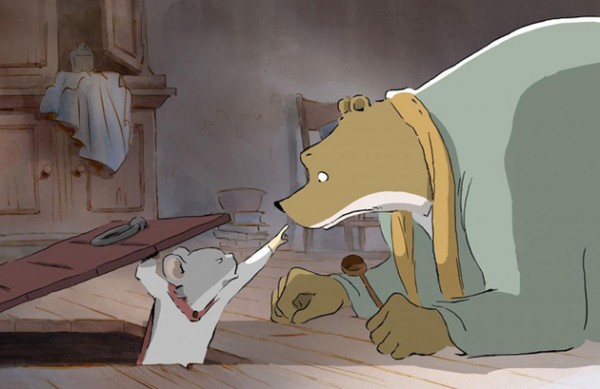
A fairly simple animation, crafted with a lot of skill, Ernest And Celestine gets by on its not insubstantial heart and its incredible hand-drawn look, which in this day and age appears all too rarely.

With an easy to follow subtext of prejudice and judgement, Stéphane Aubier, Vincent Patar and Benjamin Renner's film isn't going to win any awards for its deep and meaningful content. No matter. The tale of Ernest the bear (Lambert Wilson) and pint-sized mouse Celestine (Pauline Brunner), is involving, gorgeous to look at entirely satisfying in nature, despite its story, dragged from the drawer marked 'typical children's fable'.

Perhaps though, there is something that dares to do more here too. Celestine is a repressed artist, forced to go out and perform a manual job. Ernest is a down-and-out stage performer, forced into crime by the apathy of those who pass him by in the street. Aubier, Patar and Renner seem clearly here to be talking about the limitations imposed on those who work in the arts, particularly perhaps animation, when that animation has not been birthed from the inside of a laptop. The film starts and ends with Celestine drawing, a passion and skill you get the impression Ernest And Celestine respects a lot more than many other films.

The film is in French with subtitles which, coupled with the traditional animation, makes you suspect it won't get backed by huge amounts of UK cinemas, a crying shame, especially seeing as Disney's last attempt at this, The Princess And The Frog, did not scoop as huge box office rewards as it deserved either. Like that film, the market for this may well be found at home, where you suspect Ernest And Celestine will look sumptuous on Blu-ray.

Some technical problems do crop up. The sound mix, for example, isn't weighted heavily enough towards the music, which plays a part in the narrative and cannot be heard clearly all too often. It's a cold viewer though who focuses on that rather than the charm on screen and Aubier, Patar and Renner's film should be enough to warm many a heart if you can find a way to see it around Christmas time.


The 26th Leeds International Film Festival runs from 1st November to 18th November at venues around the city. Programming includes several UK premières, the popular Night Of and Day Of The Dead and a selection of competition films in the Official Selection.
LIFF26 - Seven Psychopaths - Cinema Review

'Martin McDonagh: now with added Quentin Tarantino.'

In Bruges re-invented the turning circular wheel of the hitman Thriller to find itself with a triangle; sure it was different and it still turned but there was something missing, something which made the new creation clunky and a bit unsatisfying.

Seven Psychopaths does a similar thing to the crime caper but sees the director of both, Martin McDonagh on much better form, remembering that his audience, and his plot, need satisfaction in amongst the cliché avoidance and rule-bending structure.

He gets off to a good start with three likeable leads. Rather than being reliant on Brendan Gleeson’s Ken in In Bruges to drag the audience along and give us some humanity in the madness, McDonagh here has Colin Farrell’s likeable, perma-drunk screenwriter Marty, Sam Rockwell’s typically zany dog kidnapper Billy and Christopher Walken’s hallucinogenic cactus-munching pacifist Hans. All of them are able to provide comic relief and likeable charm, giving Seven Psychopaths the ‘up’ from the start in both interest stakes and scripting flexibility; all get great lines and all deliver them well.

For a director so concerned with breaking convention and failing to follow the obvious path, it is a little disconcerting to find that Seven Psychopaths is yet another film in which the most obvious candidate to play the hero is a screenwriter. At some point those who spend their lives writing Hollywood scripts must wake up and realise that there are better candidates for heroes than those who spend their lives writing Hollywood scripts. Through an interwoven tale of a film-within-a-film (or at least a script-within-a-script), Seven Psychopaths does just about get away with making Farrell the main lead, but it’s a close run thing for those getting tired of this particular trope.

The whole thing though gets by on another element missing from In Bruges; charm. Farrell has oodles of it and isn’t afraid to use it, Rockwell has a canine sidekick who fills in whenever he’s lacking and Walken, well, Walken on this form could charm a pair of handcuffs off his wrists with wordplay alone. It’s a potent, entertaining and oft-hilarious mix, which achieves that rare feat and actually lives up to the promise of its early trailer. Martin McDonagh: now with added Quentin Tarantino.


The 26th Leeds International Film Festival runs from 1st November to 18th November at venues around the city. Programming includes several UK premières, the popular Night Of and Day Of The Dead and a selection of competition films in the Official Selection.

LIFF26 - Aaltra - Cinema Review

'Aaltra doesn't laugh at the disabled, it accepts that the disabled have as much power to make you laugh as the able-bodied.'

After previous successful outings at the festival, 2004's Aaltra returned to LIFF this year to, once again, a very appreciative audience. Following two newly wheelchair-bound miserabilists on a journey involving moto-cross and non-existent law suits, Gustave de Kervern and Benoît Delépine's comedy is a constant delight of visual gags and ink-black humour.

The writing and directing duo, who also star, start early, once tragedy has beset their two grumpy protagonists. As their ambulance drivers stop for a drink there are four beers on the bar but only two people visible. Very slowly, two hands reach up from the invisible bodies of the wheelchair-bound duo. It is the sign from the directors that everything has changed: even having a pint will not longer be as it was.

The agenda here is difficult to lay a finger on, until you realise that there isn't one. This isn't a film particularly for or about people with a disability. It is a film which recognises we are all human and therefore all prone to stupidity, insensitivity, despondency and ridiculous mirth-making. Aaltra doesn't laugh at the disabled, it accepts that the disabled have as much power to make you laugh as the able-bodied.

With that mantra, de Kervern and Delépine hold little back. Both of the leads are unlikeable and their journey involves swindling some German's out of a meal, stealing an electric wheelchair and terrorising a moto-cross bike designer (bizarrely played by Jason Flemyng). The pay-off at the end perhaps goes a little too far but you'll be a stronger man than the entire audience at LIFF if it doesn't make you chuckle.


The 26th Leeds International Film Festival runs from 1st November to 18th November at venues around the city. Programming includes several UK premières, the popular Night Of and Day Of The Dead and a selection of competition films in the Official Selection.

LIFF26 - Sightseers - Cinema Review

'primarily a Comedy, if murdering people whilst driving a caravan is your idea of a laugh'

Although noticeably softer in gore level and overall tone, Ben Wheatley’s Sightseers bears enough of the hallmarks to recognise it as the film from the guy who made Kill List. Where that film though was so overbearing it suffocated, and so ambiguous it alienated, his third feature is much more impressive of construction, accessible of plot and complete of vision. It’s also primarily a Comedy, if murdering people whilst driving a caravan is your idea of a laugh.

Leads Steve Oram and Alice Lowe turn in cracking performances for what really should be actor’s dream roles. Tina in particular is a repressed, neurotic gem of a character, bubbling over with inappropriate language and appropriate levels of weird affinity with Chris’s habit of bludgeoning people. Lowe's portrayal of her is little short of masterful, building Tina from child-in-woman’s-clothing to something much much more. It is an obligation at this point to mention the horrendous lack of roles like this for women in Hollywood and elsewhere, although you suspect Theron, Thurman and others might run a mile from some of Tina’s lines.

Humour isn’t necessarily a surprise here (the marketing campaign accentuated it), but just how adept at it Wheatley proves to be, is. His script includes everything from subtle-ish visual gags, to foul language as a Comedy weapon, to smart lines which call to mind Shane Black. In fact, with the inky nature of the narrative, you rather suspect Black in his heyday might have wildly approved of this and Sightseers has more in common to a Black Comedy (as opposed to a black Comedy) than the obvious touchstones of, say, Bonnie & Clyde.

There are still things that go wrong and it does feel sometimes that Wheatley is rushing through, not pausing quite enough to make us like two characters who are ostensibly the most vile people on Earth. A gag with a giant pencil doesn’t work at all and threatens to de-rail a large part of the final act and perhaps there are one too many sex gags to keep the film on the right side of good bad taste.

But Sightseers is also a film that frequently looks fantastic, thanks to Laurie Rose's cinematography, and that aims higher than it could have done whilst making us laugh. It’s grim, dark and occasionally difficult to love, but it’s also incredibly entertaining, almost entirely satisfying and very, very funny.


The 26th Leeds International Film Festival runs from 1st November to 18th November at venues around the city. Programming includes several UK premières, the popular Night Of and Day Of The Dead and a selection of competition films in the Official Selection.

LIFF26 - Vanishing Waves - Cinema Review

'the film builds dramatically and poignantly and the director shows assurance in allowing it to grip you slowly and gently'

It is horrible to criticise a film for being too ambitious but, maybe, Kristina Buozyte's Vanishing Waves would have been even more stunning had it tried to weave in slightly fewer grand ideas. In a well-managed two-hour runtime, Buozyte touches on notions of masculine fantasy, repressed sexual desire, the un-said in relationships, scientific ethics, the nature and state of our mind, death and what it constitutes.

All of that happens in a film which at times can seem bizarre but for the most part is a brave experimental Sci-Fi, full of ideas, exploration and a desire to use the genre to greater ends. This might not all become immediately apparent, seeing as the whole thing starts rather like your common or garden Erotic Thriller, a genre mainly consigned to the memory of 1980s studio executives.

Plugged in to a machine which allows him to enter the consciousness of a coma victim, Lukas (Marius Jampolskis) at first sees nothing but colours and shapes. Then he finds himself on a beach. There's a woman (Jurga Jutaite) there. She's attractive and alluring and her only desire seems to be to want to have sex with him. We have entered the area of male fantasy and, for a time, the film teeters on the brink of being a touch fatuous.

The recovery though, is something approaching epic. Vanishing Waves (originally titled Aurora, which is much better) becomes a film featuring, but not about, eroticism, as Lukas struggles with ideas of leaving the consciousness his perfect image of himself inhabits. His fantasy is all in the mind of another (helloooo, Inception) but his reality is falling apart as well as, potentially, is the reality of the coma victim.

Eventually Buozyte moves the film on to be more of an exploration of ethics in scientific study and of our understanding of how and when a person dies. Lukas' actions in the final third don't necessarily fit with the sometimes horrible traits of his character but the film builds dramatically and poignantly and the director shows assurance in allowing it to grip you slowly and gently. The final important scenes include a naked chase along a beach in near darkness, which may go down as one of the most beautiful scenes shot this year.

If there's a major problem throughout it is in the performances. Jampolskis is OK as Lukas, but he isn't leading man material and he definitely isn't hero material and Vanishing Waves suffers from lack of a central presence. Vytautas Kaniusonis too as his boss Mantas is awful, a blank face where much, much more is needed. For those reasons it would be more surprising if Hollywood did not come calling at this for a remake with major talent than if they did, such is the film world in which we live. For now though, search out Buozyte's film and be inspired, amazed and consistently surprised.


The 26th Leeds International Film Festival runs from 1st November to 18th November at venues around the city. Programming includes several UK premières, the popular Night Of and Day Of The Dead and a selection of competition films in the Official Selection.

LIFF26 - The Hunt - Cinema Review

'builds a gnawing sense of injustice and social comment which form a potent mixture of emotional resonance and formal critique... dramatising the concept of conviction and trial by public, aspersion and innuendo'

An unexpectedly terrifying film, The Hunt is an interesting interjection into the discussion of abuse by director Thomas Vinterberg. Proving, as others have already commented, to be incredibly well-timed, considering world events, The Hunt follows teacher Lucas (Mads Mikkelsen) as his life spirals out of control following an accusation of sexual abuse by a pupil.

Quite how that spiral starts proves to be the main problem in a film which, though excruciatingly good, is not short on blindingly obvious problems. As Klara (Annika Wedderkopp) is led into accusing Lucas of a heinous crime, a cavalcade of witch-like teachers, led by Grethe (Susse Wold), forms against him. Grethe talks of 'doing things by the book' and allowing the authorities to conduct a reasoned investigation, but actually does anything but. Grethe is lazy writing personified. She enables all of the events in The Hunt to happen and then disappears during the second half, literally, at one point, running away from Lucas and the story. A similar problem crops up late on when writers Vinterberg and Tobias Lindholm use an emotionally manipulative device that even Hollywood has started to shy away from.

Despite these, mainly story-related problems, it is testament to Vinterberg that The Hunt remains compelling, building a gnawing sense of injustice and social comment which form a potent mixture of emotional resonance and formal critique. As Lucas and son Marcus begin to suffer not just emotionally but physically, The Hunt dramatises the concept of conviction and trial by public, aspersion and innuendo. It misses the jugular of today's society only by never showing us a shot of a camera crew camped outside Lucas' house.

Winner of Best Actor at Cannes, Mikkelsen is more than impressive in the lead. Save for, perhaps, Denis Lavant in Holy Motors, it is difficult to think of a better performance all year. Lucas is a believably repressed and quiet divorced teacher, in a small town with small friends. When accused he retains those traits. In other hands, Lucas would suddenly become widely irrational, loud and outwardly combative. Mikkelsen's retention of the character throughout The Hunt's varied and soul-destroying plot is a masterclass.

In a good year for Danish cinema, The Hunt lost out on the country's long list nomination for Best Foreign Film at The Academy Awards (it went to A Royal Affair, also starring Mikkelsen), which will no doubt feel like a blow to Vinterberg and the team behind him. In a way though, it is an entirely accurate summation of where The Hunt should sit. This is an excellent work, and so nearly awards-worthy, but the reasons why it is not are equally as apparent as the reasons why it is, led by the gravity and brilliance of Mikkelsen, fighting against an occasionally flawed narrative.


The 26th Leeds International Film Festival runs from 1st November to 18th November at venues around the city. Programming includes several UK premières, the popular Night Of and Day Of The Dead and a selection of competition films in the Official Selection.

LIFF26 - The Ambassador - Cinema Review

'Rarely do documentaries feel so revelatory, or so dangerous.'

In a year where Sacha Baron Cohen has dressed up and played make-believe as a foreign dictator  it is refreshing and exhilarating to see Danish journalist Mads Brügger dressing up and playing a foreign diplomat for real, with noble documentarian aims. Brügger sets out in The Ambassador ostensibly to uncover some form of the truth behind the corruption that still exists in certain parts of Africa, deciding that the only way to do so is to become that very corruption. Within the film's opening twenty minutes or so Brügger, a white Dane, secures for himself the position of Liberian ambassador to the Central African Republic (CAR).

Inherent in his methods are certain levels of ethical uncertainty which have strongly turned others away from The Ambassador. Without a doubt these issues do exist. Brügger pumps money into a system he has shown to be corrupt, gives false hope to members of the CAR public and fails to explain at the end of the film what he does with material gains he receives from his experiment. There is plenty here to critique Brügger over and his methods are undoubtedly controversial.

But those very methods allow him to produce a film which gets closer to its subject than many, many documentaries, particularly when the topic is so fraught and the locale so dangerous. Brügger hits at the very heart of the corrupt system, because those who perpetrate the evils completely believe that he is one of them. The journalist's methods are unique, and uniquely risky, but the end product they produce is revelatory and consistently, grimly amazing.

There are obviously question marks over how many times Brügger can get away with doing this sort of film before he starts to be recognised and/or his game rumbled. Certainly there may be question marks over how long he wants to continue pursuing such topics, given that, by the end of the film, at least two of the major players he features are killed in mysterious circumstances. If he can bring this level of access and insight though then there should be campaigns for him to carry on. Rarely do documentaries feel so revelatory, or so dangerous.


The Ambassador plays LIFF26 again on Wednesday 14th November, 17.00, Townhall 2.

The 26th Leeds International Film Festival runs from 1st November to 18th November at venues around the city. Programming includes several UK premières, the popular Night Of and Day Of The Dead and a selection of competition films in the Official Selection.

LIFF26 - Post Tenebras Lux - Cinema Review

'Reygadas aspires to be a director who singularly fails to lead his audience by the hand. In this aspiration he has completely succeeded'

After Darkness Light runs the literal translation of Carlos Reygadas's film and, indeed, at the point the trip switch on the projector blew, plunging Leeds Townhall into said gloom, his title seemed to have been taken rather literally by the higher powers of electricity and properly regulated current.

Not all of the audience were delighted when Reygadas' titular prediction fulfilled its destiny and the projector bulb clicked back into existence. Whilst occasionally hypnotic and undoubtedly beautiful to look at, Post Tenebras Lux is also highly challenging and occasionally brutal.

Scenes of animal cruelty flick through a film that does not feel confined by structure or the need to tell a story. As Reygadas himself says in the press notes, he aspires to be a director who singularly fails to lead his audience by the hand. In this aspiration he has completely succeeded.

The director also succeeds, with the help of cinematographer Alexis Zabe, in making Post Tenebras Lux look astounding. Early scenes of young Rut running around fields bookended by pastel skies are fantastic, the location eventually becoming a thunder plain, as the titles appear word by word on blacked out heavens, streaked in purple.

But, here as well as elsewhere, Reygadas and Zabe seem to go out of their way to alienate the audience. Post Tenebras Lux is occasionally shot using a lens which creates a view almost like a fish-eye effect. At first, as we follow a donkey through the trees, it seems that this lens is used to single out point-of-view shots, but very quickly it becomes the norm, a constant annoyance, as the sides of the already narrow aspect ratio blur and duplicate.

The point of Reygadas' piece seems to be to show our dual natures; like Rut at the start in harmless pastures, we are able to offer Lux but soon comes the Tenebras and the scene changes. Lead character Juan (Adolfo Jiménez Castro) is shown as part of a warm family unit but then, soon after, he beats one of his dogs and his (our?) dark nature rises to the surface.

The cyclical light and dark repeat again and again throughout the film but the light isn't light enough and the dark is occasionally alienating. The floating story (which seems to span time whenever it wants to) is too obtuse to get a grip on and the annoying lens work doesn't encourage you to try. An enigma; beautiful and ugly, light and dark.


The 26th Leeds International Film Festival runs from 1st November to 18th November at venues around the city. Programming includes several UK premières, the popular Night Of and Day Of The Dead and a selection of competition films in the Official Selection.

LIFF26 - Room 237 - Cinema Review

'On a webpage this information can make for compelling, if anecdotal reading. What the director seems to have failed to grasp is that, as the main constituent part of a one-hundred and two minute film, it does not.'

Browse the trivia page of The Shining on IMDb and you can find all sorts of interesting factoids, omissions and errors. Jack's (Jack Nicholson) typewriter, for instance, changes colour over the course of the film, from white to blue. What does that say to you? Continuity error? Or sign that The Shining is actually Kubrick's attempt to address the holocaust?

If you answered the latter of those two options, then Room 237 is for you. Director Rodney Ascher has assembled an Avengers-esque team of The Shining obsessives, who believe in various theories regarding the film's existence, from the above to the even more outlandish.

On a webpage - IMDb's trivia page, for example - this information can make for compelling, if anecdotal reading. What Ascher seems to have failed to grasp though is that, as the main constituent part of a one-hundred and two minute film, it does not.

Theory after theory is trotted out, sometimes with evidential backup, sometimes with little more than the perpetrator's whim as 'proof'. Ascher skips between them, like someone's eye browsing the trivia page, picking out individual moments before dropping them and focusing on another. Scenes from other Kubrick films add depth but not clarity.

In all the execution is amateurish. Ascher doesn't subject the theories to any critique nor does he allow each participant long enough individually to 'pitch' their reading. The scenes from other Kubrick films add nothing. The sound recording of one participant - apparently done online or over the phone - is noticeably crackly and includes said participant's child screaming in the background.

The argument that Room 237 is not only a slightly madcap view of The Shining but also a glimpse into the lives of film obsessives is demonstrably not true; we never see any of the contributors and the film is lacking that key tour round their home which is done up to look like The Overlook Hotel, with sly shots of their red/yellow Beetle populating the background material.

Ultimately the 'insight' of the film is foiled to such a degree as to make it blunt. It is unlikely to change your world view of what The Shining is about, or anything else besides, and it won't give you a new appreciation of Horror obsessives. What it might do, is send you to sleep, or convince you of the inherent value of the brevity of IMDb trivia pages.


The 26th Leeds International Film Festival runs from 1st November to 18th November at venues around the city. Programming includes several UK premières, the popular Night Of and Day Of The Dead and a selection of competition films in the Official Selection.

LIFF26 - The Shining - Cinema Review

'an opera of slow-burning fear and expertly-conducted dread'

Stanley Kubrick's Horror masterpiece, the most striking thing about The Shining is just how early on the terror starts. Even if you aren't shaking at the low-tones throbbing over the helicopter shots in the introduction, or sensing the discomfort in Wendy's (Shelley Duvall) meeting with the doctor (Anne Jackson), there is not long to wait until Jack (Jack Nicholson) is glimpsed maniacally staring from the window at Wendy and Danny (Danny Lloyd) playing in the snow. It has begun.

From that point forwards, Kubrick's film is an opera of slow-burning fear and expertly-conducted dread. As Danny's visions increase in intensity, the film moves onwards towards the terrifying final chase, as Jack loses all semblance of humanity. The Shining should never make you jump and there is never anything horrifying enough on the screen to make you avert your eyes, yet the film is, still, incredibly scary, a perfect blend of sound design and directorial nous.

So what's it all about? Room 237 (more on that in the near future) would have it that The Shining is about the genocide of American Indians, the Nazi's extermination of The Jews and/or The Apollo moon landing. Whilst, to various degrees, some or all of those ideas may have some credence, the truth, as ever, seems to be much simpler.

The Horror of The Shining, the haunting of The Overlook Hotel and the forewarning that something is going to happen there, all come, originally, from Danny. The events aren't perpetrated by him, but he is the first to see them coming. This hints that Kubrick's film is really concerned with a child's eye view and, eventually, a child's eye view of a parental break up. Witness the scene where Jack irrationally loses his temper with Wendy over her interrupting his writing. Danny walks in with injuries on his neck. The quarrel between his parents has literally scarred him. As Danny tries to mediate in the dispute later on, by bringing in 'outside help', Jack rejects the presence of another man in the equation and continues his descent into a ruined relationship that began well before the film starts. There are, of course, other readings, but that The Shining is concerned with the destruction of the family is fairly plain.

The masterpiece status of Kubrick's film is rarely called into question and nor should it be, yet there are moments that threaten to divert the film from its course to greatness. Nicholson is, especially at the start, too vivid in his portrayal. It works in a way - so that we believe Jack when he is let loose from the constraints of sanity entirely - but it also feels forced and the actor stretched. In a reversal, Duvall actually gets worse as the film goes on, culminating in her ridiculous running style, which has drawn murmurs of laughter from audiences the world over.

Performance ticks though are things that a film as good as this can overcome. Kubrick shoots with the confidence of someone who knows they are on to something special, and the incredible tracking shots of Danny on his kart symbolise the film: a rare moment of arthouse and genre marriage, which can only result in icon status. The Shining is that film, a perfect blend of designs and ideas, which results in aspiration and terror.


The 26th Leeds International Film Festival runs from 1st November to 18th November at venues around the city. Programming includes several UK premières, the popular Night Of and Day Of The Dead and a selection of competition films in the Official Selection.

LIFF26 - Charles Bradley: Soul Of America - Cinema Review

'Spearing soul ballads and pumped up R&B riffs mark out a man who is both out of his time and has found his moment.'

An uplifting documentary about one man's rise from near-poverty to an album release at age sixty-three, Charles Bradley: Soul Of America is a successful depiction of achieving one's dreams, rising from the bottom to the top, beating the odds and several other clichés in between. The kicker? It's actually very good.

Soul singer and James Brown impersonator Bradley starts the film on the cusp of his first album release. Poull Brien's documentary charts the month or so before his record hits the stores, whilst simultaneously examining his life up to that moment, building towards a finale at Bradley's album launch party, which you suspect from very early on will be triumphant.

What actually emerges is suggested by the subtitle. This isn't just the story of Bradley - engaging, interested and talented though he is - but a look at those with broken dreams full stop. At sixty-three, the existence of Bradley's album on its own makes a great case for the argument that it's never too late. The American Dream, The Soul of America, is alive and kicking in Bradley's spirit.

And what spirit. From homelessness and the death of his brother to life in the projects, the artist's history is chequered and drama-ridden. His good humour and never-say-die attitude hide a streak of defeatism that springs to the surface only rarely, and never when he is in the company of his music. Spearing soul ballads and pumped up R&B riffs mark out a man who is both out of his time and has found his moment. The music and man are infectious.

The story that emerges is one of the good ones about one of the good ones. Bradley's honesty and humble nature make him easy company and Brien's presentation leaves room for tears and smiles in equal measure. It might not be revelatory, but as an underdog story, it is hard to imagine it being done to a better degree. Would make a perfect double bill if watched with Benda Bilili.


The 26th Leeds International Film Festival runs from 1st November to 18th November at venues around the city. Programming includes several UK premières, the popular Night Of and Day Of The Dead and a selection of competition films in the Official Selection.

LIFF26 - War Witch - Cinema Review

'focuses on a relationship as small in nature as the participants are in size but it finds life and occasional beauty and it has enough pull to tow you along'

Imagine a very worthy film about child soliders. The film you're almost certainly imagining, to a 't', is Kim Nguyen's War Witch, an honourable, solid, attempt to make a fiction out of a travesty, which is curiously devoid of innovation or much by way of the concept of originality. Is that a problem? Perhaps to some it won't be. The topic is noble enough and the story is executed well. To others though, it is OK to want more, to desire something different from an Indie film of high moral integrity.

Following child soldiers Komona (Rachel Mwanza) and Magicien (Serge Kanyinda), Nguyen embarks on a simple love story narrative, which weaves in constantly visualised ideas of the proximity of life and death in their young lives. Komona is singled out very early on by the rebels who force her into conflict as a witch, able to see the dead and communicate with them. At times throughout the narrative her visions of the chalky deceased crop up but rarely does Nguyen manage to make them haunting. Only once are they shocking.

Our investment then in the two main characters is down to their real-world actions and relationships. A warm meeting with Magicien's uncle, The Butcher (Ralph Prosper), is left a little late, although it does still find some emotional resonance. Their relationship is played out amongst harsh battle, innocent play and the realities of living in a conflict zone. It is a relationship as small in nature as the participants are in size but it finds life and occasional beauty and it has enough pull to tow you along.

Too often though, the film seems to struggle to find Drama. Events happen but stunningly little seems to come from them. Magicien has to find a white rooster in order to marry Komona. He searches and after a little while, finds a white rooster. Komona needs to escape her platoon leader. She does, and in a shocking way, but the director seems to struggle to find tension in the act. It happens, it is unpleasant and somewhat horrifying, and then we move on.

It is certainly not that War Witch is a bad film and Nguyen certainly does not shirk the inherent responsibility in approaching such a subject. But somehow it does end up as a film feeling like it is going through several oft-repeated art house motions. It is OK to want more than that.


The 26th Leeds International Film Festival runs from 1st November to 18th November at venues around the city. Programming includes several UK premières, the popular Night Of and Day Of The Dead and a selection of competition films in the Official Selection.

LIFF26 - John Dies At The End - Cinema Review

'Coscarelli never loses sight of the fact that there is humour to be had from the absurd nature of the plot's conceits.'

A hedonistic blend of all that was good about Buffy, Bill & Ted and The Hangover, John Dies At The End is a loud, occasionally loutish riot; a drunk, burbling farce, trawling through Science-Fiction, Horror and anything else director Don Coscarelli wants to throw into any given scene. That he ends up with a satisfying, eminently entertaining film, is testament to how well he manages the various elements and how devoted the film is to maintaining its sense of fun.

Whilst John (Rob Mayes) may or may not die come the film's conclusion, it is compatriot David (Chase Williamson) who takes centre stage for much of the piece. Coming down off a dose of central MacGuffin Soy Sauce, a drug which lets you do whatever the plot needs you to do at any given time, David relates the events he has experienced to journalist Arnie (Paul Giamatti). That the film attempts to play with structure is no great surprise, seeing as Soy Sauce seems able to bend time, and though the effect is simple it does lend John Dies some completeness of form.

The first half hour of Coscarelli's film is the best. Like a rejected episode of Buffy or Supernatural, David and John are set up as paranormal investigators, disguised as drug-addled stoners. The excellent pre-credits sequence - which has nothing to do with any other part of the plot - hints that the two have had an adventure or two in between the major events David describes and the time he describes them to Arnie. But then, what is time? Merely an ocean, able to bend and sway to David's will and the whims of a dog called Bark Lee.

Early laughs that play on the film's concept of time's malleable nature hit home, and establish a tone where any target is game and anything is possible. John calls David on the phone at one point from a different time, whilst sitting across from him at a table in another. 'That was me wasn't it... that was me', he giggles. In a later scene, several characters are in the back of a van. John wakes from a daze; 'are we going to the mall or coming back from it?', he asks 'no, we're going to it aren't we, because Fred is still alive'. Coscarelli never loses sight of the fact that there is humour to be had from the absurd nature of the plot's conceits.

That it does lose some degree of its hectic pacing and sly humour is perhaps inevitable considering it starts like Usain Bolt on skates, strapped to Sebastien Vettel's car. The middle section is a little boggy and the final third makes the mistake of thinking we care about the particulars of the antagonist(s). We don't. We'd much rather see Bark Lee drive a car through a house any day of the week. Whatever a week is.


The 26th Leeds International Film Festival runs from 1st November to 18th November at venues around the city. Programming includes several UK premières, the popular Night Of and Day Of The Dead and a selection of competition films in the Official Selection.

LIFF26 - Robot & Frank - Cinema Review

'The warmth Schreier finds in eighty-nine minutes is uniquely impressive... many in the audience at LIFF on Saturday lunchtime announced themselves to be rather moist of eye come the finale'

Billed as a Comedy-Drama, it is certainly the latter of those elements which rings fairest in Jake Schreier's Robot & Frank. Masquerading as something of a caper, Schreier's film is actually a gentle exploration of Alzheimer's, dressed up neatly as both farce-like parade and Science-Fiction theorising.

Both latter elements get little time to show their worth, or otherwise, in the film's tight eighty-nine minute runtime, which shows off the exemplary script by Christopher Ford. A solid laugh about Robot's (voiced by Peter Sarsgaard) self-destruct mode is about all of note from the humour front, whilst Liv Tyler's nondescript daughter pops up for a little while, notionally with the purpose of posing some ethical questions about Robot's existence. It would be nice, after some time away from the spotlight to report that Tyler is great but the opposite is true; she is weak, stilted and the worst, least convincing part of Schreier's film.

Much more convincing is the warm, occasionally tear-jerking Drama element, which sees Frank (Frank Langella) battling illness and old age, whilst trying to woo Jennifer (Susan Sarandon), pull off 'one last job' (he's an ex-thief) and palm off son Hunter (a very good James Marsden, with little to do). The warmth Schreier finds in eighty-nine minutes is uniquely impressive and it is testament to, rather than damnation of, his skill that many in the audience at LIFF on Saturday lunchtime announced themselves to be rather moist of eye come the finale.

There are though, serious undermining problems. Tyler sticks around for far too long, ruining the mood, the tone and pretty much everything else. 'Villain' Jake (Jeremy Strong) morphs from believably annoying techno-yuppie to full-on nutter with no clue, ruining any unlikeability he possessed at the start. The focus, formerly on Langella and Sarandon, is allowed to drift, meaning that, even though it has some pull, the final third could do much, much better.

Ultimately Robot & Frank is clever, and well produced for the most part. But it is also slight, and not quite as clever as its ideas seem to suggest it could have been. It's not a missed opportunity (at worst it's average), but it is frustrating to see so clear miss-steps in a film full of so much promise.


The 26th Leeds International Film Festival runs from 1st November to 18th November at venues around the city. Programming includes several UK premières, the popular Night Of and Day Of The Dead and a selection of competition films in the Official Selection.